Key Takeaways
- St. Patrick's Day offers rich opportunities to study Irish history, geography, folklore, and culture across multiple grade levels.
- Simple activities like shamrock nature study, Irish folk tales, and map work turn March 17th into a full learning day.
- Ready-made St. Patrick's Day printables save prep time so you can focus on the conversations and experiences that matter.
- The holiday connects naturally to broader spring themes, making it an easy bridge to your spring homeschool unit.
March 17th arrives every year with an invitation: slow down, go green, and actually learn something together. St. Patrick's Day homeschool activities give your children a window into Irish history, Celtic legends, geography, and the story of a real historical figure whose life was far more fascinating than the leprechaun decorations suggest. This post covers more than ten educational ideas you can use this year, along with a full facts table, curriculum connections, and printable resources designed with intention for homeschool families.
Whether your family has Irish roots or you're simply looking for a meaningful seasonal study in 2026, these activities will turn a single holiday into a week of beautiful, connected learning.
What Is the Real History of St. Patrick's Day for Children?
The real story of St. Patrick is one worth telling properly. Patrick was not Irish; he was born in Britain, likely around A.D. 385, into a Roman family. According to Smithsonian Magazine, he was kidnapped by Irish pirates at age fifteen, sold into slavery in Ireland, and spent six years as a shepherd before escaping. He later trained as a priest and returned to Ireland to share his faith, eventually becoming the patron saint of the island.
For your little one, this is a story about courage, perseverance, and purpose. It's history, biography, geography, and character study rolled into one feast day. The holiday we know today, with its parades and green rivers, grew largely out of the Irish immigrant experience in America. Smithsonian Magazine's history of the holiday notes that Boston's Charitable Irish Society held the first St. Patrick's Day parade in 1737, and the holiday wasn't even a public celebration in Ireland itself until the 20th century.
That context is worth sharing with your children. It turns a fun holiday into a genuine history lesson.
Did You Know? Fun Facts About Ireland and St. Patrick's Day
Use this table as a read-aloud discussion starter or copy it onto a notebooking page for your children to illustrate.
|
# |
Fun Fact |
|
1 |
St. Patrick was not Irish. He was born in Britain and brought to Ireland as a slave at age 15. |
|
2 |
The color originally associated with St. Patrick was blue, not green. Green became popular in the 18th century. |
|
3 |
Ireland's nickname, "the Emerald Isle," comes from its lush green landscape, shaped by its mild, rainy climate. |
|
4 |
The shamrock became a symbol when St. Patrick reportedly used its three leaves to explain the concept of the Christian Trinity. |
|
5 |
There are no native snakes in Ireland. The legend of St. Patrick "driving out the snakes" is widely understood as a symbol for driving out paganism. |
|
6 |
St. Patrick's Day was a quiet religious holiday in Ireland until the 1970s; pubs were actually closed on March 17th for most of the 20th century. |
|
7 |
The first St. Patrick's Day parade in America was held in Boston in 1737, organized by the Charitable Irish Society. |
|
8 |
Chicago dyes its river green every year for St. Patrick's Day, using an orange vegetable dye that turns green in the water. |
|
9 |
Ireland is the only country where St. Patrick's Day is a national public holiday. |
|
10 |
A leprechaun is a figure from Irish folklore, traditionally depicted as a small cobbler who hides a pot of gold at the end of a rainbow. |

10+ St. Patrick's Day Learning Activities for Homeschool Families
These activities are designed to span multiple subjects and grade levels. Pick the ones that fit your family's current studies, or use them across the full week leading up to March 17th.
1. Read a Biography of St. Patrick
Begin with the primary source: Patrick's own story. Find an age-appropriate biography or a retelling of his life from captivity in Ireland to his return as a missionary. For younger children, read aloud and narrate together. Older students can journal a character response: What qualities made Patrick remarkable? This is a natural fit for your character education and history studies.
2. Study the Map of Ireland
Pull out a blank map of Europe and have your children locate Ireland, the British Isles, and the surrounding seas. Discuss why Ireland's island geography shaped its history, including its distinct Celtic culture and the fact that no land-dwelling snakes ever crossed the water to reach it. Add the major cities, rivers, and the phrase "Emerald Isle" with a key explaining why.
3. Explore Celtic Knotwork as an Art Activity
Celtic knotwork is one of the most distinctive art traditions in the world. Introduce your children to the interlocking patterns found in illuminated manuscripts like the Book of Kells. Have them practice drawing simple knot patterns on graph paper, then discuss how these designs were used to decorate sacred texts and stonework across Ireland for centuries.
4. Learn About the Shamrock and Botany
The shamrock is a variety of clover, and St. Patrick's Day is the perfect excuse to study it. Take your children outside to look for clover in the yard or a nearby green space. Sketch the leaves, compare a three-leaf clover with a rare four-leaf variety, and discuss the simple biology of leaf structure. This connects beautifully with your spring nature study; see our post on spring nature study for homeschoolers for ideas on building this into a broader unit.
5. Read an Irish Folk Tale
Irish folklore is rich and varied. Choose a traditional tale such as "Finn MacCool," "The Children of Lir," or a story about the Tuatha Dé Danann. After reading, have your children narrate or illustrate the story. Discuss what the tale teaches about the values of the culture that created it. Folk tales make excellent springboards for grammar copywork and narration exercises.
6. Make a Shamrock Notebooking Page
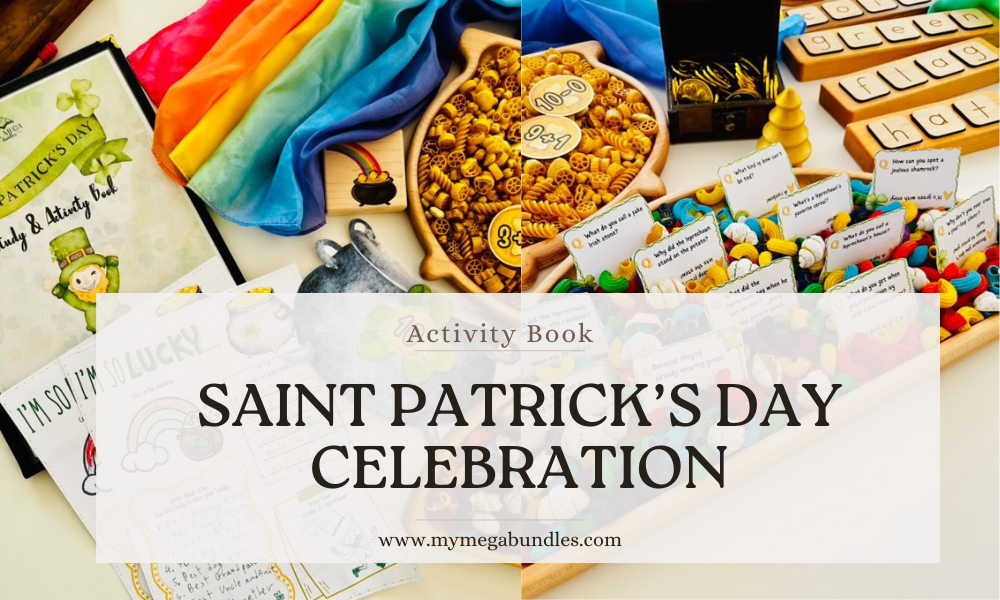
Notebooking is a cornerstone of classical homeschooling, and a shamrock-themed page gives your children a beautiful way to record what they've learned. Each of the three leaves can represent a different area of study: history (St. Patrick's life), culture (Irish traditions), and geography (Ireland on the map). Our St. Patrick's Day Activity Book ($12) includes ready-made notebooking pages, copywork, and activities designed specifically for homeschool families.
7. Study the Irish Flag and Its Meaning
The Irish tricolor flag, with its green, white, and orange stripes, carries a meaningful story. Green represents the Gaelic tradition, orange represents the supporters of William of Orange, and white represents peace between them. Have your children sketch and color the flag, then write a short narration about what each color represents. This leads naturally into a discussion of Irish history and identity.
8. Copywork and Dictation with an Irish Proverb
Irish proverbs are vivid, lyrical, and full of wisdom. Choose one appropriate for your child's level for a copywork or dictation exercise. Some excellent options include: "A good laugh and a long sleep are the two best cures" or "Is minic a bhris béal duine a shrón" (Many a time a man's mouth broke his nose). The second provides a gentle introduction to the Irish language, Gaelic (Irish), which is still spoken in parts of Ireland today.
9. Cook a Simple Irish Recipe Together
Food is history. Make a simple Irish soda bread or a pot of vegetable soup and use the cooking time to discuss Irish agricultural history, the Great Famine of the 1840s (appropriate for older students), and the wave of Irish immigration to America that followed. For younger children, simply focus on the sensory experience and the joy of making something together with their hands.
10. Compare St. Patrick's Day Then and Now
Using what your children have learned about the history of the holiday, have them create a simple T-chart or written comparison: How was St. Patrick's Day celebrated in 5th-century Ireland? How is it celebrated in America today? This higher-order thinking exercise works well for children in grades 3 and up and reinforces comprehension skills.
11. Explore Irish Music and Dance
Play recordings of traditional Irish music, including the tin whistle, uilleann pipes, and fiddle. Discuss how music was passed down orally in Celtic culture. If you have an older student interested in music history, compare a Celtic reel to a piece of classical music studied earlier in the year. You can also watch a short clip of traditional Irish step dancing and discuss how it differs from ballet or folk dance traditions from other cultures you've studied.
12. Use a Ready-Made St. Patrick's Day Activity Book
When you want a full, structured learning day without the prep work, our St. Patrick's Day Activity Book ($12) brings it all together. It's designed with intention for homeschool families who want more than coloring pages: expect age-appropriate history content, creative activities, and pages that connect to real learning goals. Pair it with our Spring Activity Book ($7.50) to extend the seasonal learning all the way through April and May.

Connecting St. Patrick's Day to Your Broader Spring Curriculum
St. Patrick's Day sits at the beginning of spring, which makes it a natural doorway into your seasonal studies. The shamrock and clover are excellent starting points for a plant and botany unit. The geography of Ireland connects to any world cultures or continents study. The biography of St. Patrick fits into a history of Christianity thread or a broader study of the ancient world.
If you're exploring March themes this year, St. Patrick's Day pairs beautifully with Women's History Month. Our post on Women's History Month homeschool activities offers another layer of meaningful content for your March schedule. And when you're ready to carry the momentum forward into spring nature study, our spring nature study guide will help you build connected, seasonal learning across the weeks ahead.
A Note from a Homeschool Mom
"We've been using the St. Patrick's Day Activity Book for two years now, and my children actually ask to do it every March. The history pages gave us the best conversation we've had all semester about what it means to be brave. It's one of those resources I'm glad I found early on."
— Sarah M., homeschool mother of three
Frequently Asked Questions
What are some educational St. Patrick's Day activities?
Educational St. Patrick's Day activities include studying the biography of St. Patrick, mapping Ireland and the British Isles, reading Irish folk tales, learning about Celtic art and knotwork, exploring the symbolism of the shamrock, and discussing the history of Irish immigration to America. These activities cover history, geography, literature, art, and science, making the holiday a rich, multi-subject learning day.
How do you celebrate St. Patrick's Day in homeschool?
Homeschool families typically celebrate St. Patrick's Day by combining structured activities with festive ones. Read a biography together, complete a notebooking page or map activity, cook a simple Irish recipe, and enjoy a folk tale read-aloud. Many families use ready-made printable resources to anchor the day, then add their own traditions such as wearing green, decorating with shamrocks, or listening to traditional Irish music.
What is the history of St. Patrick's Day for children?
St. Patrick was a real historical figure born in Britain around A.D. 385. He was kidnapped by pirates as a teenager and enslaved in Ireland, where he worked as a shepherd. After escaping, he trained as a priest and returned to Ireland to share Christianity with its people. He became the patron saint of Ireland, and March 17th, traditionally considered the date of his death, was set aside to honor him. The holiday remained a quiet religious feast in Ireland for centuries; the lively parades and celebrations we associate with it today grew out of Irish immigrant communities in America, beginning in the 1700s.
Bring St. Patrick's Day to Life This March
St. Patrick's Day is one of those holidays that rewards a little extra effort. When you look past the green decorations and into the real story of a man who chose to return to the land where he'd been enslaved, you find a narrative that resonates with children at every age. Pair that story with beautiful seasonal activities, and you have the kind of school day your little one will remember.
Our St. Patrick's Day Activity Book ($12) is ready to download and print today, with everything you need for a full, intentional learning day. And if you're building out your full spring curriculum, the Spring Activity Book ($7.50) makes a wonderful companion from March through May. Happy St. Patrick's Day from our family to yours.