Key Takeaways
- Treasure Island is appropriate for children in grades 4 through 8, with adaptations available for younger readers.
- A structured book study approach, including vocabulary work, narration, and character analysis, makes classic literature accessible and enjoyable.
- You can pair the novel with hands-on activities like mapmaking, creative writing, and oral narration to build comprehension across subjects.
- A ready-made Treasure Island Book Study takes the planning burden off your plate entirely.
- You picked up Treasure Island, flipped to the first page, and thought, "This is exactly the kind of book I want my children to love." Then you closed it and wondered where on earth to start. Teaching classic literature in a homeschool takes more than reading chapters aloud together, and it's completely normal to want a plan before you dive in.
This guide walks you through everything you need to teach Treasure Island with confidence, from choosing the right edition for your child's age to building a chapter-by-chapter study that weaves in writing, vocabulary, history, and critical thinking. You'll also find a grade-level comparison table, a step-by-step teaching plan, and answers to the questions homeschool parents ask most about this beloved adventure novel.
What Is Treasure Island, and Why Does It Belong in Your Homeschool?
Treasure Island is a 1883 adventure novel by Robert Louis Stevenson. It follows young Jim Hawkins from a sleepy English inn to a treacherous island in search of buried pirate gold. Along the way, Jim encounters one of literature's most memorable villains, Long John Silver, and is forced to make difficult decisions about loyalty, courage, and trust.
It belongs in your homeschool for several reasons. First, the vocabulary and sentence structure give children a meaningful encounter with formal literary English, which builds reading comprehension far more effectively than simplified texts. Second, the moral complexity of the story, where characters are rarely all good or all bad, gives you rich material for discussion. Third, it's genuinely thrilling. Children who "don't like reading" often surprise themselves with Treasure Island.
The novel is available in its complete original form for free at Project Gutenberg, which makes it an accessible choice for any family.
Choosing the Right Edition for Your Child
For children in grades 4 and 5, an illustrated abridged edition can ease them into the language without losing the story's momentum. For grades 6 and up, the unabridged text is absolutely within reach, especially with vocabulary support alongside each chapter. If you're reading aloud with a mixed-age group, the unabridged version works beautifully because your voice carries the rhythm and tone that makes the prose come alive.
What Grade Level Is Treasure Island Best Suited For?
Treasure Island is generally best suited for children in grades 4 through 8, though a confident reader in grade 3 can enjoy an abridged version. The Lexile measure of the unabridged text is approximately 1020L, which places it firmly in the upper-elementary to middle school range.
That said, grade level in a homeschool is less fixed than in a classroom. A nine-year-old who reads widely will often engage with this novel more deeply than an older child who reads reluctantly. The table below gives you a practical breakdown by age and approach.
Grade-Level Reading Approaches for Treasure Island
|
Grade Level |
Approach |
Edition |
Key Focus Areas |
|
Grade 3-4 |
Read-aloud with parent |
Illustrated abridged |
Story comprehension, narration, vocabulary in context |
|
Grade 4-5 |
Guided reading with discussion |
Abridged or lightly edited |
Character traits, sequencing, beginning narration writing |
|
Grade 5-6 |
Independent or paired reading |
Unabridged with support |
Vocabulary study, plot analysis, creative writing responses |
|
Grade 6-7 |
Independent reading with study guide |
Unabridged |
Theme analysis, moral reasoning, essay writing |
|
Grade 7-8 |
Full literary study |
Unabridged |
Author's craft, literary devices, comparative writing |
This table is a starting point, not a rule. Trust what you know about your own child's reading level and stamina.
How Do You Teach Classic Literature in a Homeschool?
Teaching classic literature well comes down to three things: preparation, conversation, and response. You don't need a teaching degree, and you don't need to know every literary term. What you do need is a consistent structure so that reading Treasure Island feels like a subject, not just story time.
Here is a method that works at every age level.
Read with Purpose, Not Just Pleasure
Before each reading session, preview the chapter title and ask your child what they predict will happen. After reading, ask them to narrate back what occurred in their own words. This simple oral narration habit builds comprehension and retention far better than comprehension questions alone.
Build Vocabulary Before It Becomes a Barrier
Treasure Island has wonderful, unusual words: "flibbertigibbet," "binnacle," "ague." If your child stumbles over unfamiliar words, the story loses momentum. Pull out 3 to 5 vocabulary words from each chapter before you read, give brief definitions, and then notice them together during the reading. Our Treasure Island Book Study includes pre-selected vocabulary lists for every chapter so you don't have to do this prep yourself.
Use Discussion Questions That Go Beyond the Plot
The best literature conversations aren't about what happened, they're about why it happened and what it means. With Treasure Island, you'll find no shortage of moral questions: Is Long John Silver a villain or a survivor? Did Jim make the right choice when he slipped away from the camp? Should loyalty ever be broken? These conversations are where classic literature earns its place in a homeschool education.
Include a Written or Creative Response
After every two to three chapters, give your child a response activity. This might be a narration paragraph, a character sketch, a map update, or a journal entry written from Jim's perspective. Written response deepens engagement and builds composition skills at the same time.
Step-by-Step Guide to Teaching Treasure Island in Your Homeschool
Step 1: Gather Your Materials
Download or order a copy of Treasure Island (the free Project Gutenberg edition is excellent for older children). Print or purchase your study guide. Gather a blank notebook for narrations and responses, and a large piece of paper for an ongoing treasure map your child can draw and add to throughout the study.
Step 2: Preview the Book as a Family
Before you read chapter one, spend 15 minutes exploring the novel together. Look at the map of Treasure Island included in most editions. Talk about who wrote it and when, and why the Victorian era was so fascinated with pirates and exploration. This context makes the story richer from page one.
Step 3: Establish a Reading Schedule
Treasure Island has 34 chapters, which can feel like a lot. A manageable pace is two to three chapters per week, which spreads the study over 11 to 17 weeks, fitting neatly into a semester. If you prefer a more intensive approach, four chapters per week completes the novel in about eight weeks.
Step 4: Read and Narrate Each Session
Read aloud or have your child read independently, then ask for an oral narration before discussion begins. Keep a running "story so far" summary on a whiteboard or in the notebook so events stay fresh.
Step 5: Work Through Vocabulary and Activities
After narration and discussion, move to the vocabulary and activity work for that chapter set. Activities might include copywork passages, character comparison charts, creative writing prompts, or map work. Our Treasure Island Book Study provides all of these activities in a print-and-use format, designed with intention for grades 4 through 8.
Step 6: Complete a Final Project
A meaningful final project brings the whole study together. Options include writing a book review, creating an illustrated story map, writing a new chapter that continues the adventure, or staging a narration of a favourite scene. The goal is for your child to demonstrate not just what they read, but what they understood and felt about it.

What Treasure Island Activities Work Best for Homeschoolers?
Hands-on activities make classic literature stick, and Treasure Island lends itself to some genuinely wonderful ones.
Mapmaking. The island map is one of the most iconic images in all of adventure literature. Have your child draw their own version of Treasure Island based on the descriptions in the text. Update it as new locations are revealed. This activity builds close-reading skills while giving your child something beautiful to keep.
Pirate Code Writing. After reading about the pirates' articles of agreement in chapter two, have your children write their own "code" for a fictional crew. This is a surprisingly effective exercise in persuasive writing and logical thinking.
Character Morality Chart. Create a simple chart with all major characters and assess each one's honesty, loyalty, and courage at different points in the story. Long John Silver alone provides enough nuance for a rich discussion.
Creative Journaling. Have your child keep a journal written as Jim Hawkins, one entry per chapter set. This builds narrative writing skills and emotional engagement with the text at the same time.
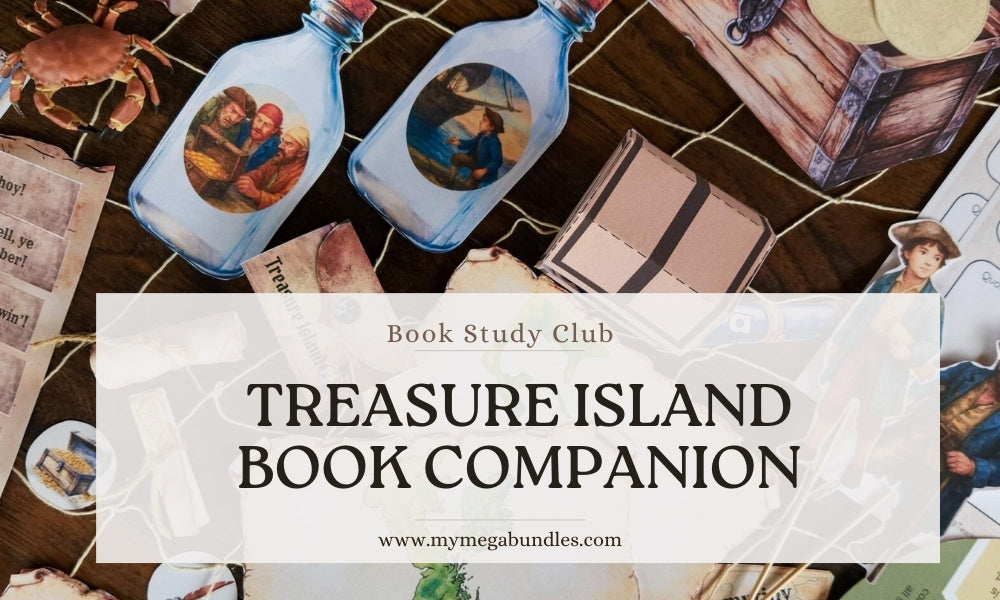
If you'd like a full set of structured, ready-to-print activities, our Treasure Island Book Study includes mapmaking sheets, vocabulary builders, narration prompts, comprehension questions, and a final project guide, all for $13.
How the Treasure Island Book Study Fits Into a Bigger Literature Program
One of the most common concerns homeschool parents share is how to build a coherent, progressive literature program across the years. A single book study is a wonderful starting point, but pairing it with other titles from a similar era or with complementary themes creates genuine depth.
If your children are younger and you're looking for a gentler introduction to structured story study, our 3 Little Pigs Book Study Companion ($8) uses the same narration and activity approach with a familiar fairy tale, making it ideal preparation for longer novel studies.
For families who want a steady supply of thoughtfully curated book studies throughout the year, our Book Study Club offers new titles on a regular basis so your literature program is always growing. It's a simple, beautiful way to ensure classic literature stays central to your homeschool without requiring constant planning on your part.
You might also enjoy pairing Treasure Island with outdoor learning. Nature study and literature make a wonderful combination, and our posts on flower pressing with children and spring nature study in your homeschool are full of ideas for meaningful learning that gets your children outside between reading sessions.

A Note from a Fellow Homeschool Family
"We used the Treasure Island Book Study with my 10-year-old son and it transformed the way he engages with books. The vocabulary work and the character charts were his favourite parts. He finished the novel and immediately asked what we were reading next. I can't recommend it enough." — Sarah M., Homeschool Mom of three
Frequently Asked Questions
What grade is Treasure Island appropriate for?
Treasure Island is appropriate for children in grades 4 through 8. Younger readers in grades 3 and 4 can enjoy an abridged or illustrated edition read aloud with a parent, while children in grades 6 and up can typically manage the unabridged text independently with vocabulary support. The story's themes of courage, loyalty, and moral complexity become richer as children mature.
Is Treasure Island considered a children's book?
Treasure Island was originally serialised in a children's magazine called Young Folks between 1881 and 1882, so yes, it was written with a young audience in mind. However, it has been embraced by readers of all ages for nearly 150 years. Its moral complexity and literary craft make it a genuine work of literature rather than a simple children's adventure story.
What is the moral lesson of Treasure Island?
Treasure Island does not offer one simple moral, which is part of what makes it so valuable for discussion. The novel explores the tension between loyalty and self-interest, the unreliability of first impressions, and the cost of greed. Jim Hawkins learns that courage means acting rightly even when you're afraid, and that people, like Long John Silver, can be both admirable and deeply flawed at the same time.
How do you teach classic literature in homeschool?
Teaching classic literature in a homeschool is most effective when built around three habits: oral narration after each reading session, vocabulary preparation before reading, and a written or creative response after every few chapters. A structured book study guide takes the planning work off your plate and ensures your child builds comprehension, vocabulary, and writing skills simultaneously. Discussion questions that explore character motivation and moral themes create the meaningful conversations that make classic literature memorable.
Bring Treasure Island to Life in Your Homeschool This Year
Teaching Treasure Island is one of those homeschool experiences your children will talk about for years. The story is vivid and exciting, the characters are genuinely complex, and the moral questions it raises are exactly the kind you want to be exploring together. With a clear plan, good discussion questions, and activities that connect to real skills, this classic novel becomes one of the highlights of your school year.
Our Treasure Island Book Study is designed with intention for families just like yours: practical, thorough, and beautiful to use. At $15, it's the most affordable way to give your child a rich, structured encounter with one of literature's greatest adventure stories.
Whether you're planning your 2026 literature curriculum now or looking for your next read-aloud, Treasure Island is ready and waiting. And so is a guide to help you teach it beautifully.